Genesis says the lights in the sky were made for signs and appointed times. People read them for thousands of years. Then the zodiac was tied to the seasons, the calendar was changed and the words were renamed. The stars kept moving. Soulcode reads your birth against where they really were.
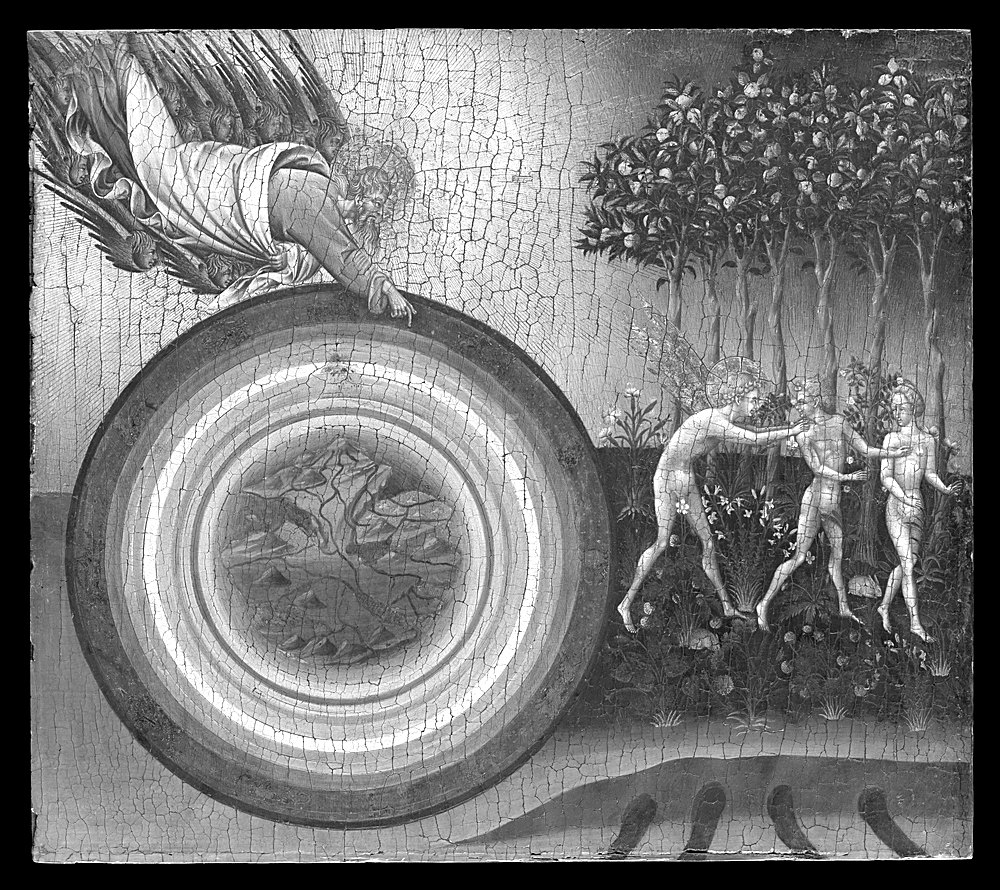
Giovanni di Paolo, The Creation of the World and the Expulsion from Paradise, 1445
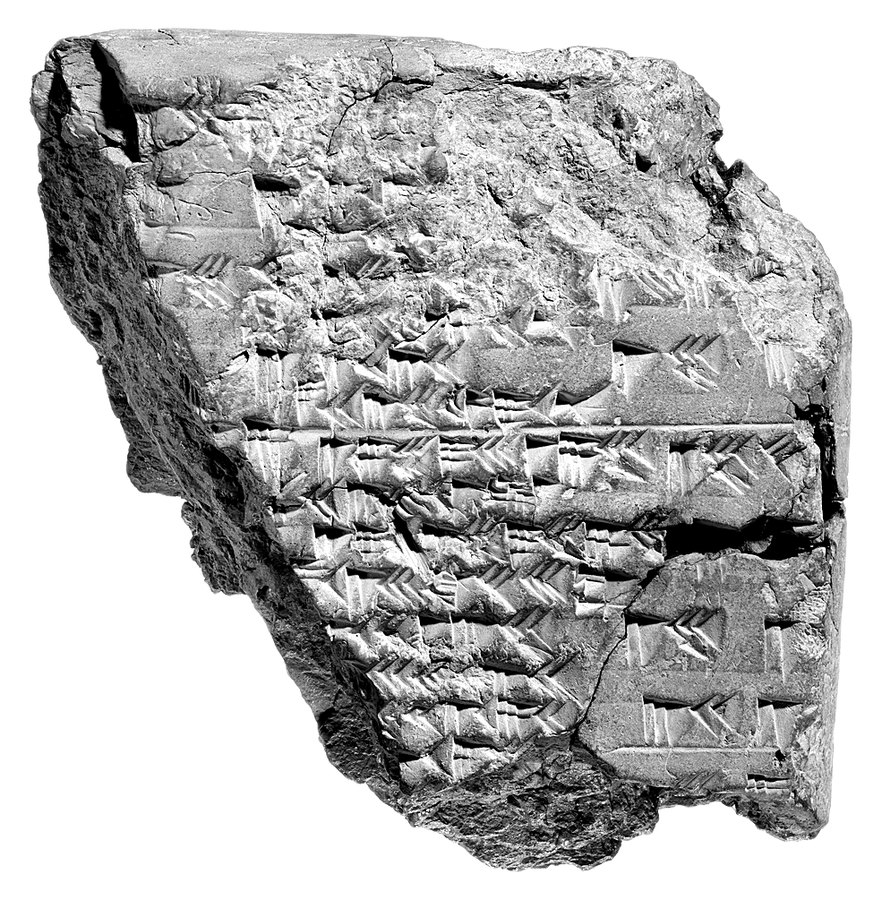
Clay tablet listing eclipses. Babylonia, 4th to 2nd century BC
0
The thread
Every culture on earth that looked up long enough came to the same conclusion. The sky was not decoration. It was keeping time, and it was saying something.
The Babylonians wrote it down for more than two thousand years. The Hebrews built their whole year around it. The Maya counted it without missing a single day for centuries. The men who found a child in Bethlehem followed it across a desert. And the first page of the most read book in history says the lights in the sky were put there for signs.
You were handed almost none of this. You were handed a horoscope in the back of a magazine, a calendar invented by a pope, a clock built for factories, and a vocabulary full of words whose meanings were swapped out while no one was watching. You were told the old knowledge was superstition, and the people who kept it were backward.
I did not set out to prove that. I followed one thread, and it kept going. What follows is the thread, in order, from the first word ever spoken to the last book ever written. Every date in it can be checked. Every quote has a source. Where something is a tradition and not a fact, I say so.
Nothing here was hidden in a vault. It was hidden in plain sight, which works better.
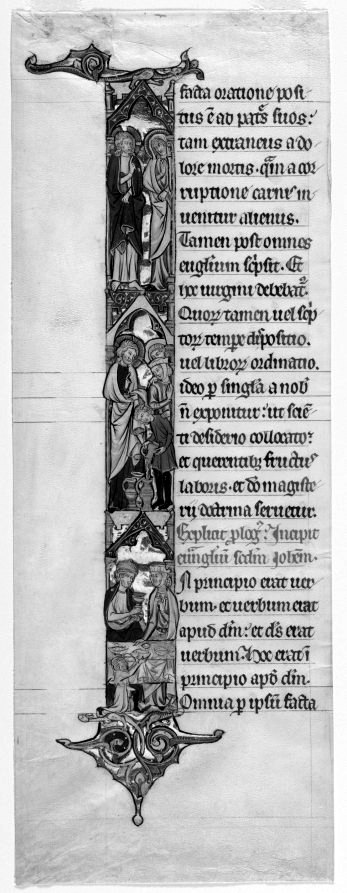
The opening of John: In principio erat verbum, "In the beginning was the Word." Latin Bible, Cambrai, c. 1260 to 1270
I
The Word
The Bible opens before anything exists. "In the beginning God created the heavens and the earth. The earth was formless and empty, darkness was over the surface of the deep, and the Spirit of God was hovering over the waters."
The Hebrew word for Spirit is ruach. It means breath and wind as much as it means spirit. The word for hovering, merachefet, is used elsewhere for an eagle beating its wings over its nest. Before a single thing is made, there is breath moving over deep water, close and vibrating.
Then God speaks. "Let there be light." And there is light. That is the entire mechanism of creation in Genesis 1. Ten times God speaks, and ten times something exists that did not exist before. Nothing is built with hands. Everything is called into being by a word.
Then comes the only moment in the account where God stops and deliberates: "Let us make mankind in our image." The Hebrew is tzelem. It does not mean a body. God has no body in this story. It means function. God speaks and order appears; God names things; God separates light from dark and calls it good. The one creature made in that image is the one who can do the same: speak, name, create order out of chaos.
Two thousand years later, John opened his gospel on purpose with the same three words: "In the beginning was the Word, and the Word was with God, and the Word was God." The Greek for Word is Logos. It does not really mean a word. It means the reason, order and intelligence running underneath everything. Greek philosophers had been circling it for five hundred years. John says it has a name.
Logos is also the root of every -ology you have ever studied. Biology, psychology, theology, astrology, technology. Every field of human knowledge is named as a branch of that one Word.
If the world was spoken into being, then words are not small. Hold on to that. It matters later.
The recordGenesis 1:1 to 1:27. John 1:1. Hebrew terms: ruach, merachefet (Genesis 1:2; compare Deuteronomy 32:11), tzelem (Genesis 1:26). Heraclitus on the Logos, c. 500 BC.
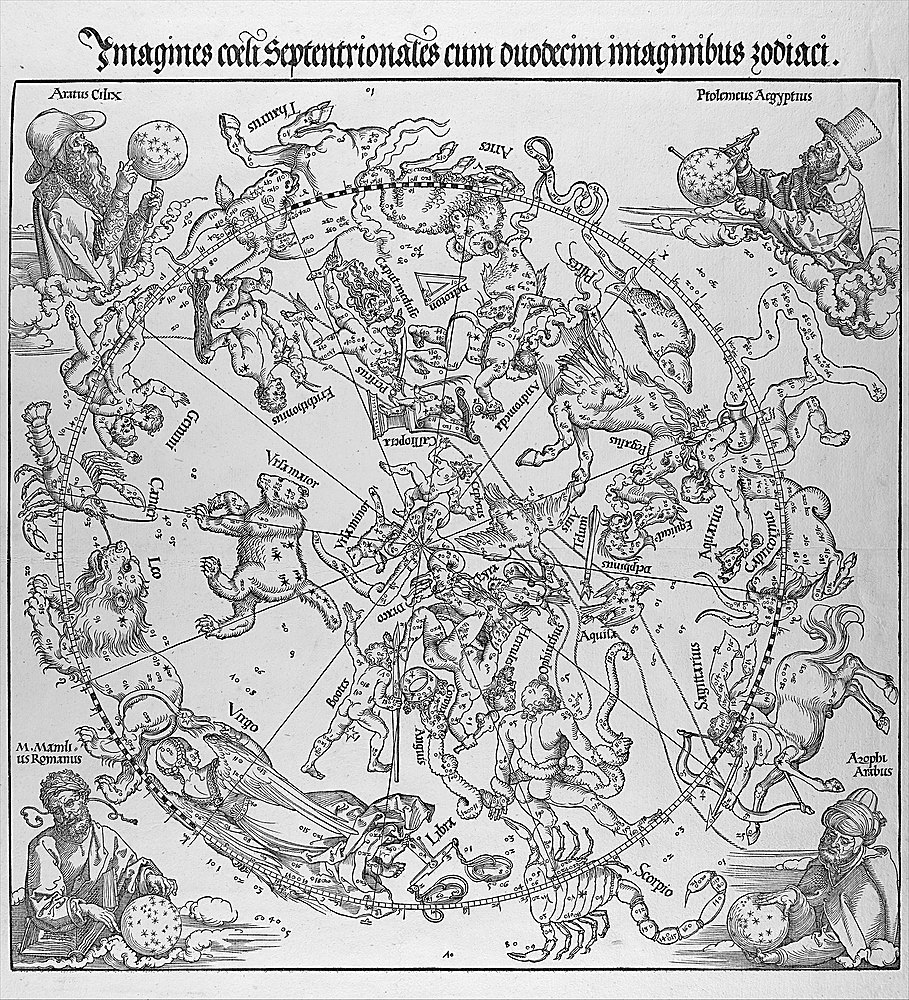
Albrecht Dürer, map of the northern sky with the twelve signs, 1515
II
For signs
On the fourth day of creation, before any animal and before any human, the sky is switched on. Read what the text says it is for:
"Let there be lights in the vault of the sky to separate the day from the night, and let them serve as signs to mark sacred times, and days and years."Genesis 1:14
The word translated signs is otot, the same word used for the rainbow after the flood and for the miracles in Egypt: a sign that carries a message. The word translated sacred times is moadim. It means appointments. It is the same word Leviticus uses for God's feasts: Passover, Pentecost, the Day of Atonement. The sky was installed as a calendar of appointments between heaven and earth.
The rest of the Bible keeps saying so. "The heavens declare the glory of God; the skies proclaim the work of his hands. Day after day they pour forth speech; night after night they reveal knowledge. Their voice goes out into all the earth." That is Psalm 19. Paul quotes it in his letter to the Romans to argue that no one on earth was ever left without a message.
In the book of Job, God asks Job a series of questions from the storm. One of them: "Can you bind the chains of the Pleiades? Can you loosen Orion's belt? Can you bring forth the Mazzaroth in its season?" Mazzaroth is the Hebrew word for the constellations of the zodiac. It appears nowhere else in the Bible. God is describing the signs of the zodiac as his own work, moving on his schedule.
The sky was online before we arrived. We were born into a language that was already speaking.
The recordGenesis 1:14 (otot, moadim). Leviticus 23:2, 4 (moadim, the appointed feasts). Psalm 19:1 to 4. Romans 10:18. Job 38:31 to 32 (Kimah, Kesil, Mazzaroth).
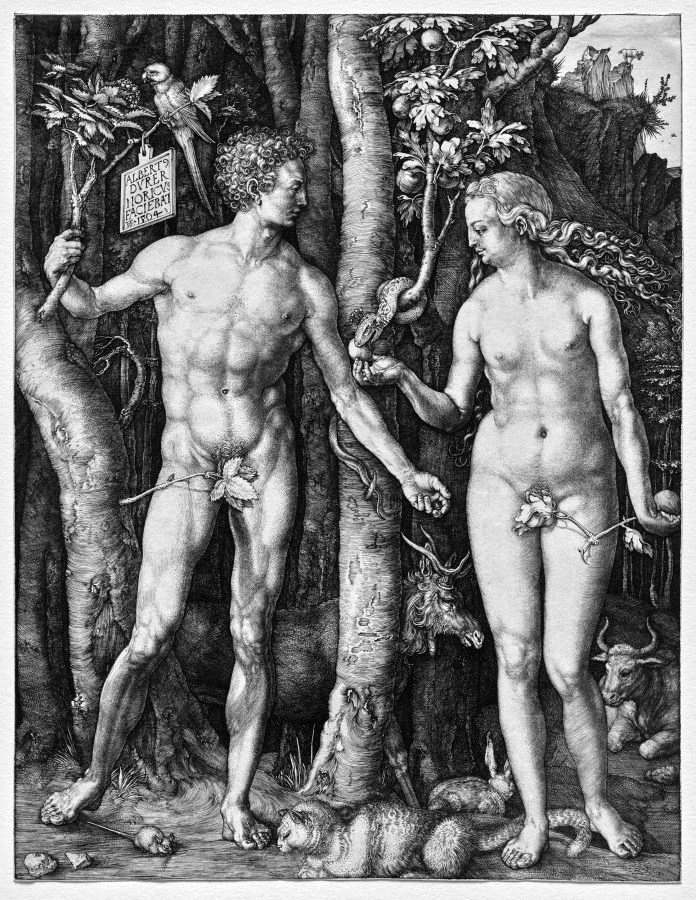
Albrecht Dürer, Adam and Eve, 1504. The serpent is in the tree. The fruit is still in her hand
III
The first lie
Genesis 2 zooms in. The human is formed from the dust like clay on a potter's wheel, and God breathes the ruach into him. He is placed in a garden, in abundance, and given the first job ever described: to work it and take care of it.
Two trees stand in the middle of the garden. The Tree of Life, and the Tree of the Knowledge of Good and Evil. Eat from any tree, God says, except that one.
Then a serpent speaks, and the first thing it does is twist a word. "Did God really say you must not eat from any tree in the garden?" God said one tree. The serpent says all of them. The woman corrects it, and the serpent goes further: "You will not certainly die. Your eyes will be opened, and you will be like God."
Notice the method. The first deception in the Bible is not violence and not force. It is a small change to what was said, delivered as a question, followed by a promise. It works. They eat, their eyes open, and the first thing they see is that they are naked. They hide.
God walks in the garden in the cool of the day and calls: "Where are you?" Not because he does not know. The question is the point. The Tree of Life is still standing, but now cherubim with a flaming sword guard the way back to it. Everything else in the Bible, every covenant and prophet and king, is the long story of getting back to that tree.
The first weapon used against humans was an edited sentence. It has never been retired.
The recordGenesis 2:7, 2:15 to 17, 3:1 to 24.
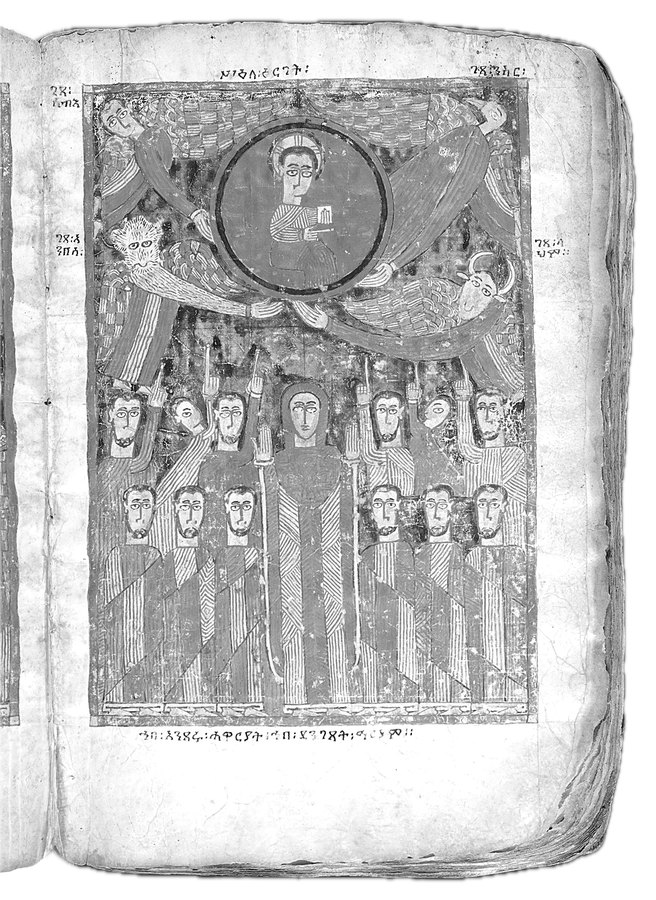
Book of the Gospels. Ethiopia, late 1300s to early 1400s. The church that kept Enoch
IV
The Watchers
Genesis 6 contains four verses most people have never had explained to them. "The sons of God saw that the daughters of humans were beautiful, and they married any of them they chose... The Nephilim were on the earth in those days." Then the flood.
There is an entire book that explains those four verses. It is called the Book of Enoch, after the man in Genesis who "walked with God, and he was not, for God took him." In it, two hundred angels called the Watchers come down on Mount Hermon, bind themselves with an oath, and take human wives. Then they teach humans what they were never supposed to have.
"Baraqiel taught astrology, Kokabel the constellations, Ezeqeel the knowledge of the clouds, Araqiel the signs of the earth, Shamsiel the signs of the sun, and Sariel the course of the moon."1 Enoch 8:3
Along with weapons, cosmetics, sorcery and enchantments. The earth fills with violence, and that is why the flood comes.
But the book does not say the sky is evil. Later in the same book, Enoch himself is taken up and shown the true laws of the lights by the archangel Uriel: how the sun moves through its gates, how the moon grows and shrinks, and a year of exactly 364 days, fifty-two weeks, so that the appointed times never drift. Two kinds of sky knowledge, in one book. The true one, given by God. And a stolen, corrupted copy, taught by the Watchers to control people.
Here is why you have never heard of it. The Book of Enoch was read and treasured by Jews and by the first Christians. The letter of Jude in the New Testament quotes it word for word. Copies in Aramaic were found among the Dead Sea Scrolls at Qumran. And then, over the next few centuries, the Western church dropped it. The Jewish canon did not keep it. The Catholic and Protestant Bibles do not contain it.
One church kept it the whole time. The Ethiopian Orthodox Tewahedo Church, one of the oldest churches in the world, has always had Enoch in its Bible, along with the Book of Jubilees, which uses the same 364-day year. For more than a thousand years, the only complete copies of Enoch on earth were in Ge'ez, the old language of Ethiopia. Europe only saw it again in 1773, when a Scottish traveler named James Bruce brought copies home.
A book quoted inside the New Testament was left out of your Bible. The people who kept it are the ones the West calls poor.
The recordGenesis 5:24, 6:1 to 4. 1 Enoch 6 to 8 (the Watchers), 72 to 82 (the Astronomical Book, the 364-day year). Jude 1:14 to 15 quotes 1 Enoch 1:9. Aramaic Enoch fragments from Qumran Cave 4 (4Q201 and others). Jubilees 6:32. The Ethiopian canon of 81 books. James Bruce, 1773.
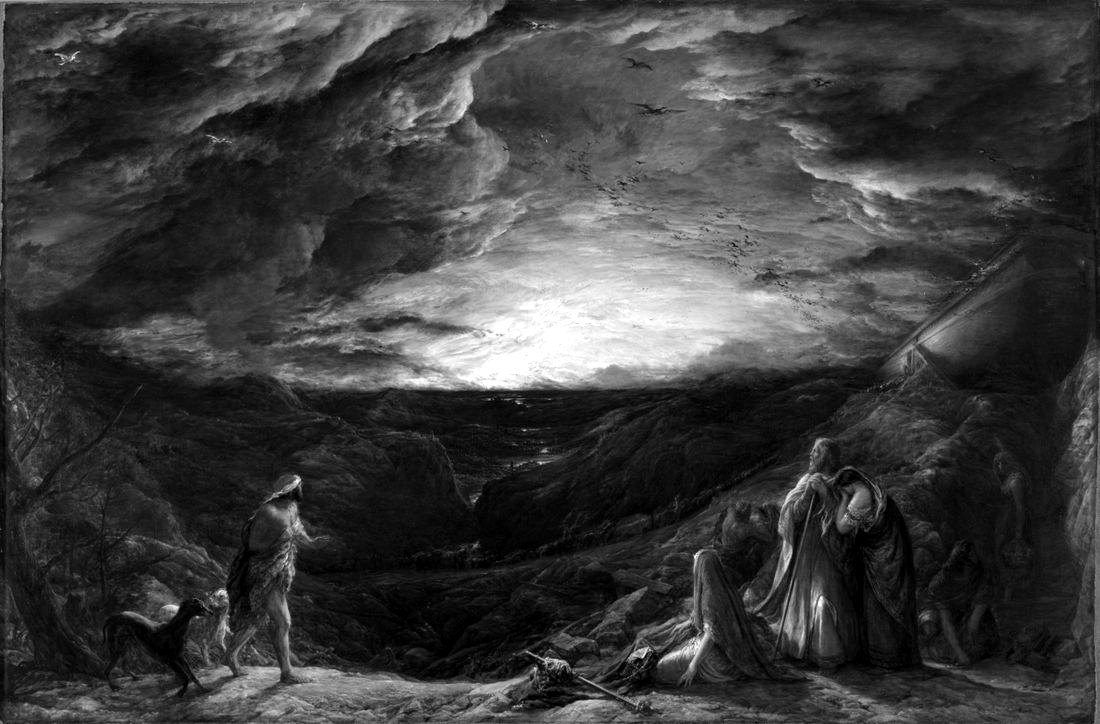
John Linnell, Noah: The Eve of the Deluge, 1848
V
The bow in the cloud
The flood in Genesis runs creation backward. On day two, God separated the waters above from the waters below. In the flood, "all the springs of the great deep burst forth, and the floodgates of the heavens were opened." The order that was spoken into being falls apart, and the world goes back toward the formless deep of Genesis 1:2.
One man walks with God, the same phrase used for Enoch. Noah is given exact instructions, down to the measurements of the ark. He survives because he is aligned with the one who holds the deep back.
When the water drains, God makes the first covenant in the Bible, with every living thing, and puts a sign in the sky. The Hebrew word for what we call the rainbow is qeshet. It is the same word used for a warrior's bow. God hangs his weapon in the clouds, pointed away from the earth.
The rainbow was a sign in the sky before it was anything else. A bow, unstrung, hung where everyone could see it.
The recordGenesis 6:9, 6:14 to 16, 7:11, 9:12 to 17 (qeshet).
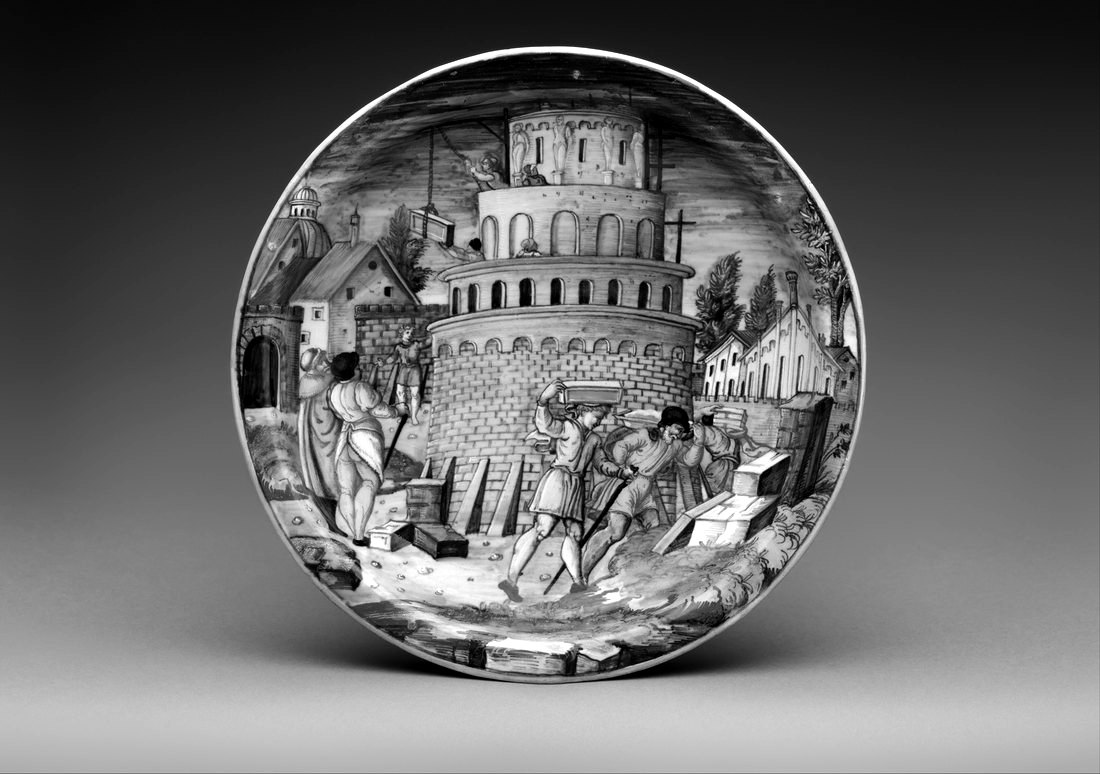
The Building of the Tower of Babel. Painted plate, workshop of Guido Durantino, Urbino, c. 1550 to 1560
VI
Babel
After the flood, the whole earth has one language. People settle on a plain in Shinar, in southern Mesopotamia, and say: "Come, let us build ourselves a city, with a tower that reaches to the heavens, so that we may make a name for ourselves."
God's answer is to confuse their language so they can no longer understand each other. The city is called Babel. In Hebrew, the name sounds like balal, to confuse or mix up. In the Babylonians' own language, the name was Bab-ili: the gate of the god.
That one city carries both meanings for the rest of history. To its own people, a gate to heaven. To the Bible, the place where human speech was broken. Babylon becomes the empire that destroys Jerusalem. And at the very end of the Bible, "Babylon the Great" is the name for the whole system of the world before it falls.
It is also where the sky was read more carefully than anywhere else on earth. The Babylonian priests recorded the heavens every night for centuries. Their omen library, called Enuma Anu Enlil, holds around seven thousand observations. Their astronomical diaries run from about 650 BC to the first century BC. Their chief god, Marduk, was the planet Jupiter. They worked out the cycles of eclipses and wrote down when the next ones would come.
The same place that broke human language also built the most detailed record of the sky in the ancient world.
The recordGenesis 11:1 to 9. Revelation 17 to 18. Enuma Anu Enlil (compiled c. 1600 to 1200 BC). The Babylonian Astronomical Diaries, c. 652 to 61 BC.
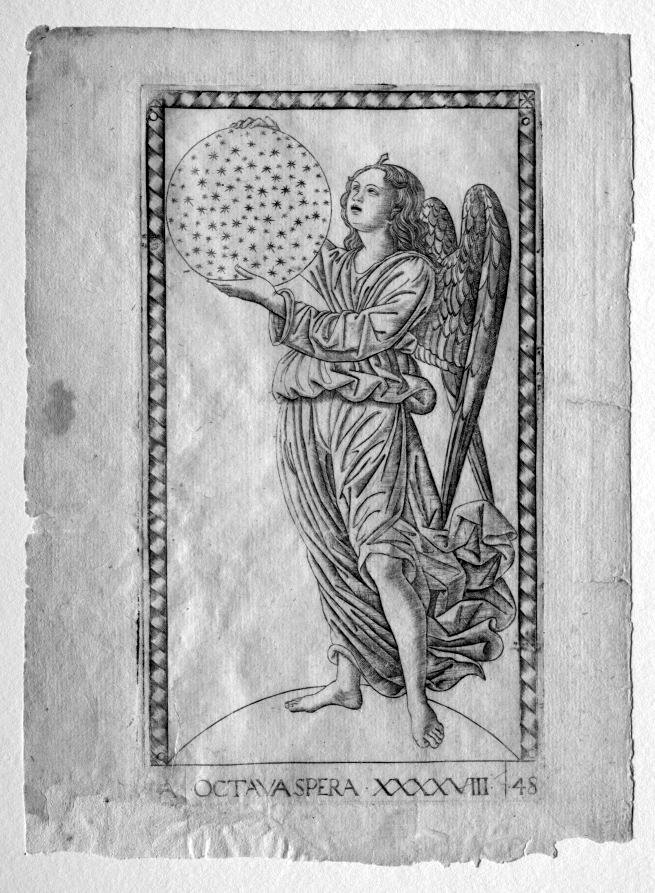
The Angel of the Eighth Sphere, the sphere of the fixed stars. Tarocchi engraving, Ferrara, before 1467
VII
Count the stars
Abram comes from "Ur of the Chaldeans." The Chaldeans were so famous as sky readers that for the Greeks and Romans, the word Chaldean simply meant astrologer. Abram grew up in the capital of the sky.
God calls him out of it. "Leave your country, your people and your father's household, and go to the land I will show you." Then, when Abram is old and still has no son, God takes him outside at night: "Look up at the sky and count the stars, if indeed you can count them. So shall your offspring be."
The rabbis noticed something in that verse. In the Midrash, Abram protests that he has looked at his own stars, his mazal, and they say he will never have a son. God answers: go out from your astrology. The stars show what is, but they do not have the last word over the people God has called. The Talmud puts it in three words: ein mazal le-Yisrael, Israel is not ruled by the stars.
That is a very different position from "the stars are fake." It says the sky is real and readable, and that there is Someone above it. It is also why, to this day, the Hebrew blessing for good news is mazal tov. Literally: a good constellation.
Every time someone says mazal tov at a wedding, they are wishing the couple good stars. Most of them have no idea.
The recordGenesis 11:31, 12:1 to 3, 15:5. Genesis Rabbah 44:12. Babylonian Talmud, Shabbat 156a. "Chaldaei" as the Latin word for astrologers (for example Cicero, On Divination).
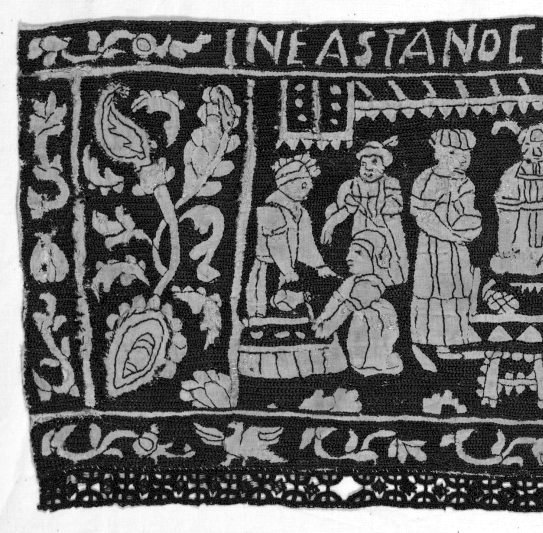
Baking the unleavened bread for the first Passover. Embroidered border, Italy, 1500s to 1600s
VIII
The appointed times
The night before Israel leaves Egypt, God gives Moses one instruction before any other law: "This month is to be for you the first month, the first month of your year." The first commandment given to the nation was a calendar.
It was a calendar read directly off the sky. A month began when witnesses saw the first thin crescent of the new moon and reported it to the court in Jerusalem. The year was kept in step with the harvest by watching the season. The day itself begins at sunset, because Genesis says "there was evening, and there was morning, the first day." The seventh day, the Sabbath, is a day nobody works, set apart from the start of creation.
When the Temple fell and the Jewish people were scattered, the sightings could no longer be sent from Jerusalem. So around the year 359, a leader named Hillel II published the calculation: a fixed cycle of 19 years, seven of them with a thirteenth month, that keeps the Moon and the Sun in step. Jewish communities everywhere on earth have used that same calendar ever since.
Think about what that means. For almost two thousand years, observant Jews have lived on time that no king, pope or government set for them. Their week ends on the seventh day, the one God rested on. Their day starts at dark. Their months start with the Moon. Their year starts in the fall with the Feast of Trumpets and turns in the spring with Passover. Their holy days are the moadim of Genesis 1:14, still being kept. Their children are raised knowing which month it is by the sky.
Their mystics went further. The Sefer Yetzirah, the oldest book of Jewish mysticism, gives each of the twelve Hebrew months a letter, a sign of the zodiac, a tribe of Israel and a sense of the body. The month you were born in has a letter. The Hebrew alphabet itself is made of numbers, so every name and every date carries a value.
Inside Judaism there was even a fight over the calendar. The community that wrote the Dead Sea Scrolls rejected the Temple's moon calendar and kept the 364-day year from Enoch and Jubilees. They believed the priests in Jerusalem were celebrating God's appointments on the wrong days.
Their lives look different from ours because their time is different from ours. It is still set by the sky.
The recordExodus 12:1 to 2. Genesis 1:5, 2:2 to 3. Mishnah Rosh Hashanah 1 to 2 (witnessing the new moon). Hillel II and the fixed calendar, c. 359. Sefer Yetzirah 5. The Qumran calendar texts (4Q319 and others).
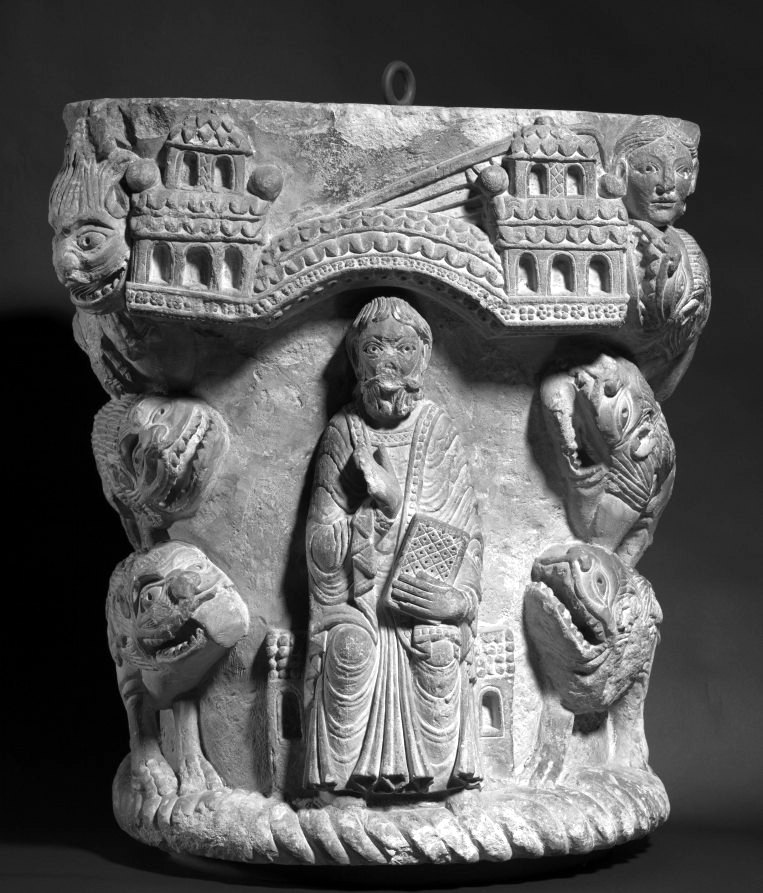
Daniel in the lions' den, with the angel sent to shut their mouths. Carved stone, France, c. 1125 to 1150
IX
Chief of the magi
In 586 BC, Babylon destroys Jerusalem and carries its people back to the plain of Shinar. Among the captives is a teenager named Daniel.
Daniel is trained in the language and learning of the Chaldeans, the sky readers. When King Nebuchadnezzar has a dream none of his experts can interpret, Daniel tells him what it was and what it meant. The king makes him ruler over the province and "chief over all the wise men of Babylon." Later, the queen describes him as the man the king made "master of the magicians, enchanters, Chaldeans and diviners."
So a Hebrew prophet sat at the top of the Babylonian sky schools. He also received the most precise prophecy of timing in the Bible: seventy "sevens" from the command to rebuild Jerusalem until the coming of an anointed one.
The Persians who conquered Babylon had their own priestly class of dream readers and sky watchers. Their name for them was magush. The Greeks wrote it magos, and the plural is magi. It is where the word magic comes from. Many Christian writers have believed that Daniel's writings stayed in that eastern tradition for five hundred years, waiting.
The men who came looking for a king in Bethlehem came from the same schools a Hebrew prophet once led.
The recordDaniel 1:4, 2:48, 5:11, 9:24 to 27. Herodotus 1.101 on the Magi of the Medes. The link between Daniel and the magi of Matthew 2 is a tradition, not a documented fact.
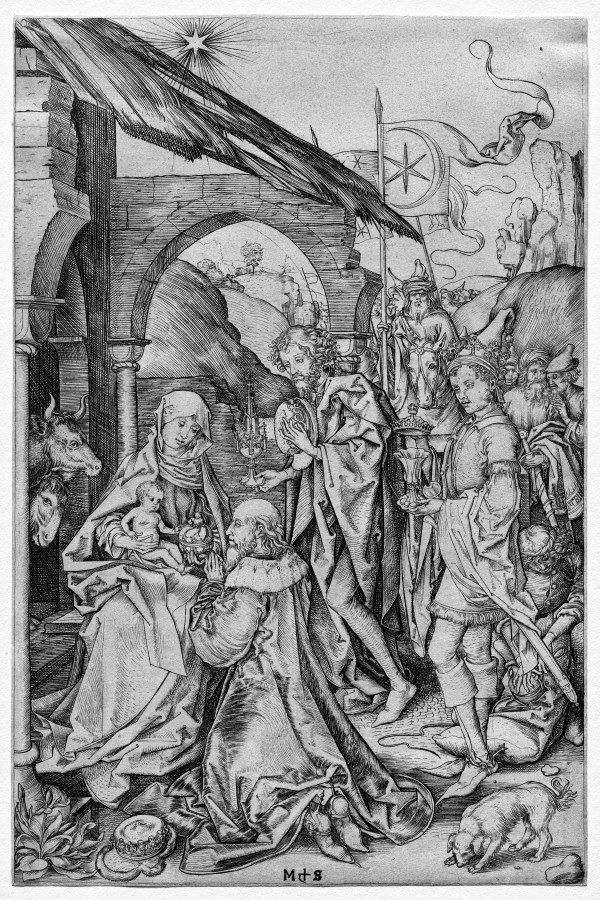
Martin Schongauer, Adoration of the Magi, 1482. The star stands over the house
X
The star
"After Jesus was born in Bethlehem in Judea, during the time of King Herod, magi from the east came to Jerusalem and asked, 'Where is the one who has been born king of the Jews? We saw his star when it rose and have come to worship him.'"Matthew 2:1 to 2
In the year we call 7 BC, Jupiter and Saturn met in the sky three times in one year: at the end of May, at the start of October and in early December. All three times, they met in the constellation of the Fishes, Pisces. That happens about once every 800 to 900 years.
To a sky reader in the east, each piece meant something. Jupiter was the royal planet, the star of Marduk, king of the gods. Saturn was linked in some ancient traditions with the Jewish people and their Sabbath. And the Fishes sat in the part of the sky associated with the lands to the west of Babylon.
There is a clay tablet in the British Museum called the Star Almanac of Sippar. It lists the positions of the planets for that year, including the meetings of Jupiter and Saturn. It was calculated in advance. They saw it coming.
In 1603, the astronomer Johannes Kepler watched Jupiter and Saturn meet again and worked backward. He calculated the same triple conjunction in 7 BC and proposed that it was what the magi had seen. He also noticed that these great conjunctions return through the zodiac on a cycle of about 800 years, and that the turning points lined up with turning points in history. He published it in 1606.
The magi were professionals using the system installed on the fourth day. They read it, they crossed nations, and they arrived at the right house.
It recorded him before he arrived.
The recordMatthew 2:1 to 12. Jupiter-Saturn conjunctions of 7 BC (29 May, 29 September to 2 October, 4 to 6 December in the Julian calendar; checked with the Swiss Ephemeris). The Star Almanac of Sippar (British Museum). Johannes Kepler, De Stella Nova, 1606. The link between Saturn and the Jews appears in Tacitus, Histories 5.4.
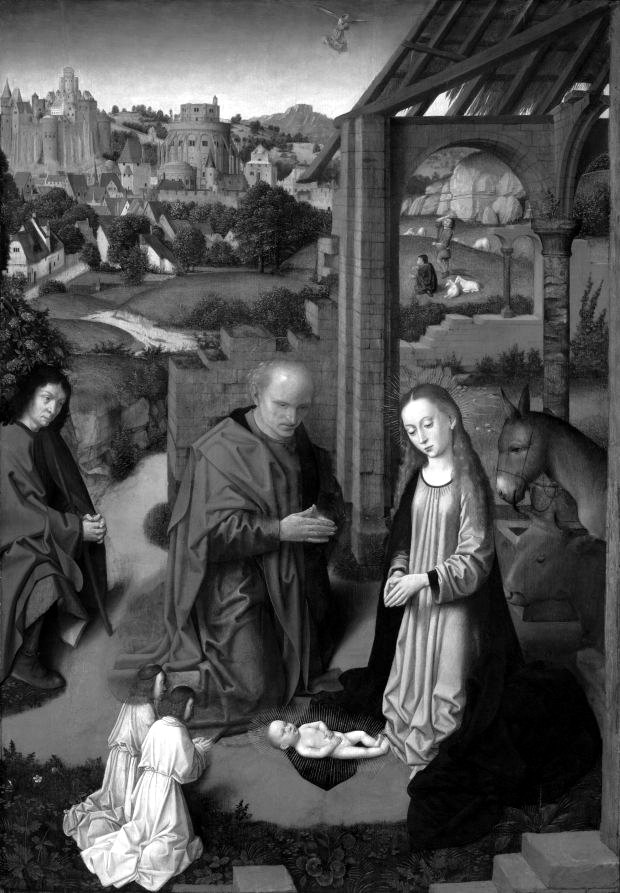
Gerard David, The Nativity, c. 1485 to 1490
XI
The Word became flesh
John 1:14: "The Word became flesh and made his dwelling among us." The Greek for made his dwelling is eskenosen. It means he pitched a tent. It is the same idea as the Tabernacle, the tent in the wilderness where God's presence lived with Israel. The Logos, the order underneath everything, moved into a human body.
His name was Yeshua. It is built from two pieces. Yah, the short form of the divine name YHWH, the name God gave Moses at the burning bush: I AM WHO I AM. And shua, from the root yasha, to save, to set free, to deliver from a narrow place. The name means: the LORD saves. His name was his job description.
Some teachers point out something about the divine name itself. The four Hebrew letters, Yod He Vav He, are all soft letters that can be spoken almost as pure breath. Said without vowels, the name sounds close to breathing: in, and out. It is a beautiful observation. It is also a meditation, not a rule of Hebrew grammar, so hold it that way. But it fits Genesis. The first thing God gave the human was his breath.
He said things no teacher in Israel had ever said. "Before Abraham was, I am." The religious leaders understood exactly what he was claiming and picked up stones. He also said this: "Whoever believes in me will do the works I have been doing, and they will do even greater things than these."
He did not only say worship me. He said you will do this too. More than this.
The recordJohn 1:14 (eskenosen), 8:58, 14:12. Exodus 3:14. Matthew 1:21 ("you are to give him the name Jesus, because he will save his people"). The breath reading of YHWH is a modern devotional teaching, popularized by Richard Rohr and others.
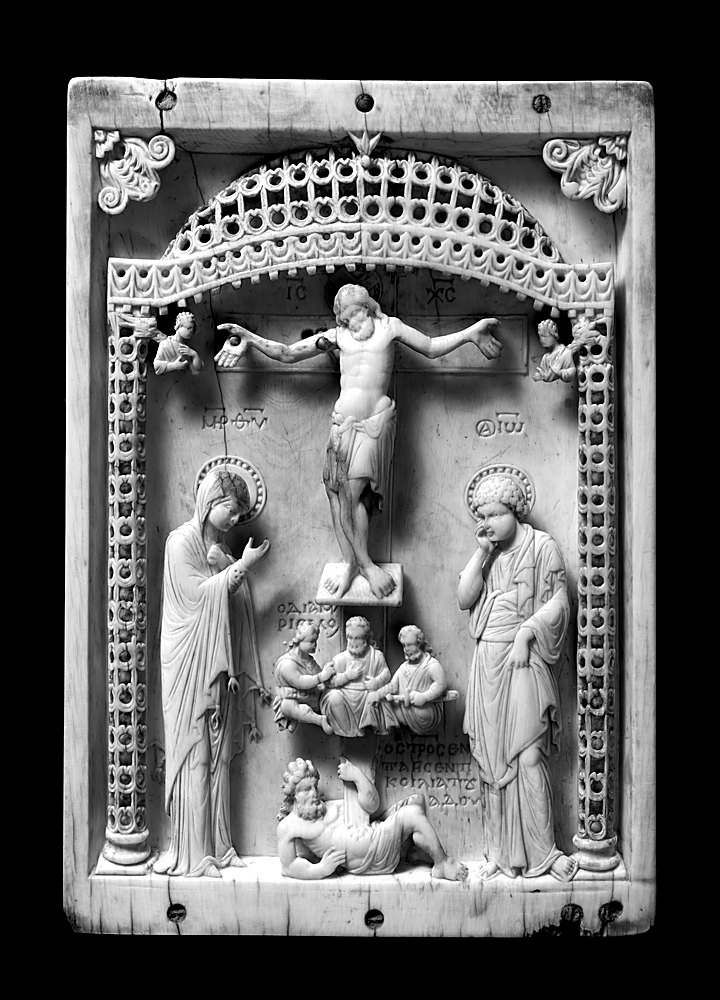
Icon of the Crucifixion, ivory. Byzantium, mid 900s
XII
The moon turned to blood
He was crucified at Passover. The same feast that remembers the lamb whose blood on the doorpost made death pass over the house. When John the Baptist first saw him, he said: "Look, the Lamb of God, who takes away the sin of the world."
From noon, darkness covers the land for three hours. The curtain of the Temple, the barrier in front of the Holy of Holies that only the high priest could pass once a year, tears in two from top to bottom. His last word in John's gospel is tetelestai. It means it is finished, completed, carried all the way through. The same word has been found written on ancient receipts, meaning paid.
In 1983, two Oxford scientists, Colin Humphreys and Graeme Waddington, calculated the sky over Jerusalem for the Passovers of those years. They found that on Friday, April 3, AD 33, the Moon rose over Jerusalem already in eclipse, partly covered and colored red.
Seven weeks later, at Pentecost, Peter stood up in Jerusalem and quoted the prophet Joel to the crowd: "The sun will be turned to darkness and the moon to blood before the coming of the great and glorious day of the Lord." He was speaking to people who had seen both, fifty days earlier.
The prophecy named a blood moon. The sky produced one. The crowd had watched it rise.
The recordJohn 1:29, 19:30 (tetelestai). Matthew 27:45 to 51. Exodus 12. Acts 2:14 to 21, quoting Joel 2:31. C. J. Humphreys and W. G. Waddington, "Dating the Crucifixion", Nature 306 (1983). Lunar eclipse of 3 April AD 33, checked with the Swiss Ephemeris.
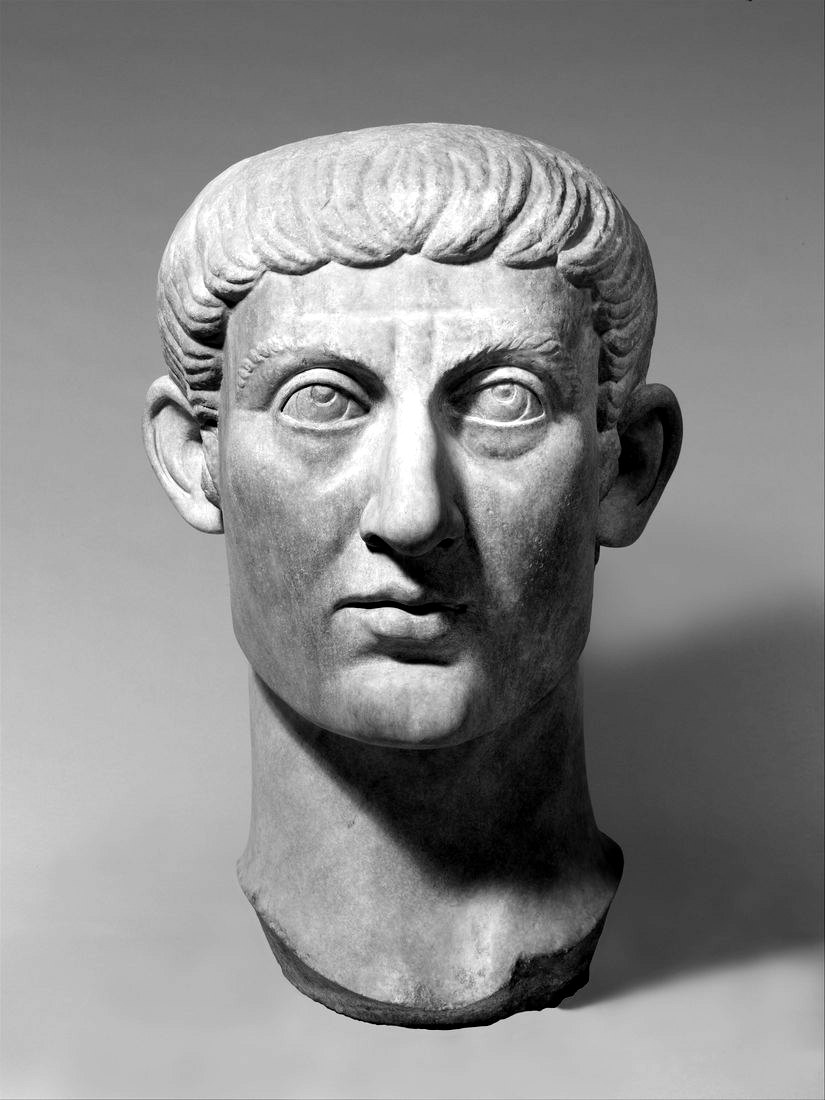
The Emperor Constantine, who called the Council of Nicaea in 325. Marble, Rome, c. 325 to 370
XIII
What was cut
The first Christians were Jews. They kept the Sabbath. They celebrated the resurrection at Passover, because that is when it happened. In Asia Minor, the churches taught by the apostle John kept it on the 14th day of the month of Nisan, the Passover date, whatever day of the week it fell on.
Around the year 155, Polycarp, a bishop who had been taught by John himself, traveled to Rome to talk with the bishop there, Anicetus, about the date. They disagreed. Rome kept it on a Sunday. Polycarp kept the apostolic date. They parted in peace, each keeping his own.
That peace did not last. In 325, the Roman emperor Constantine called the Council of Nicaea. One of its decisions was that the whole church would celebrate Easter on the same Sunday, calculated by the church, no longer by the Jewish calendar. The emperor explained the reason in a letter to the churches afterward:
"It appeared an unworthy thing that in the celebration of this most holy feast we should follow the practice of the Jews... Let us then have nothing in common with the detestable Jewish crowd."Constantine, letter after Nicaea, in Eusebius, Life of Constantine 3.18
Read that again. The date of the resurrection was pulled away from the Passover it fulfilled, and the reason given was to stop sharing anything with the Jews. The appointed time from Genesis 1:14 was replaced by a calculation. In the same centuries, the lists of which books belonged in the Bible were being settled, and books like Enoch and Jubilees fell out in the West.
In 1054, the church split in two. The Orthodox churches of the East, Greek, Russian, Syrian, Coptic, Armenian, Ethiopian and others, went one way. Rome went the other. The Western world grew up inside the Roman half. Most people in the West today have never been inside an Orthodox church, never heard its liturgy, and have no idea it kept older practices, older fasts, older books and an older calendar.
The faith was not only handed down. It was also edited. The East kept more of the original than the West was ever told.
The recordEusebius, Church History 5.23 to 25 (the Quartodeciman dispute, Polycarp and Anicetus). The Council of Nicaea, 325. Eusebius, Life of Constantine 3.18 to 19. The Great Schism, 1054.
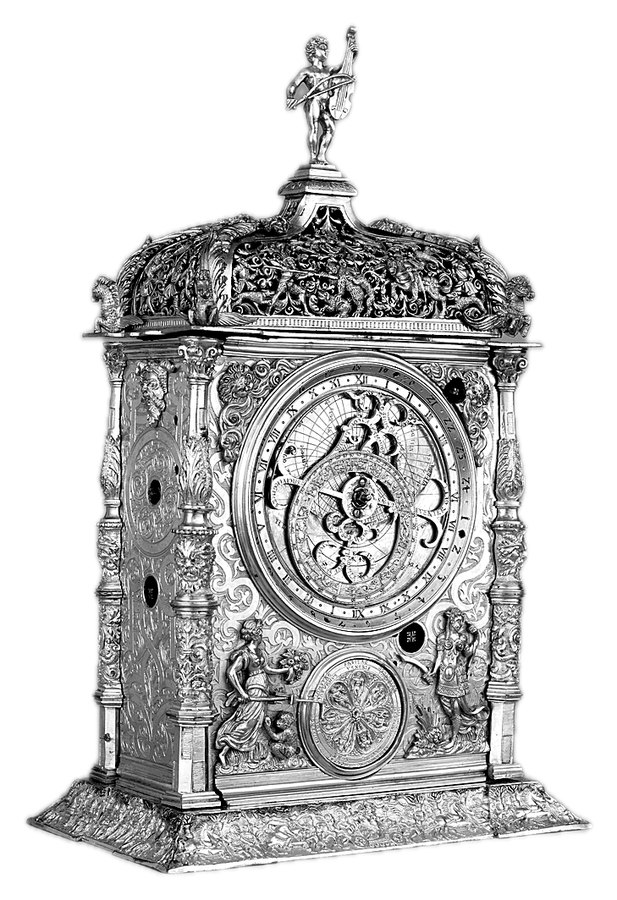
Astronomical clock by Jeremias Metzger, 1568. Fourteen years later, ten days vanished
XIV
Ten days erased
By the 1500s, the calendar Julius Caesar introduced had drifted. It counted the year as 365 and a quarter days, eleven minutes too long, and the spring equinox had slid about ten days early.
In 1582, Pope Gregory XIII issued a papal bull called Inter gravissimas. In Catholic countries, Thursday, October 4 was followed by Friday, October 15. Ten days were deleted from history overnight. Leap years were changed. The calendar you use today, the one on your phone, is named after him: the Gregorian calendar.
Not everyone went along. Protestant England refused a pope's calendar for 170 years, until 1752, when eleven days were dropped at once. Russia switched only in 1918, after the revolution. Greece in 1923.
The Orthodox churches never switched for their holy days at all. That is why Orthodox Christmas falls on January 7: it is December 25 on the old calendar, which now runs 13 days behind. The Ethiopian church runs its own ancient calendar, and Ethiopia is still on it as a country.
Look at what the Gregorian calendar is made of. Twelve months of 28, 29, 30 or 31 days with no pattern. Weeks that do not fit into months. Months that have nothing to do with the Moon, even though the word month comes from moon. Two of the months are named after Roman emperors, July for Julius Caesar and August for Augustus. September, October, November and December mean the seventh, eighth, ninth and tenth months, and they are now the ninth, tenth, eleventh and twelfth.
Nothing in it lines up with anything in the sky. It works. It just does not listen.
The recordInter gravissimas, 24 February 1582. The British Calendar Act of 1750, applied in September 1752. Russia, February 1918. Greece, March 1923. The old Julian calendar now trails the Gregorian by 13 days.
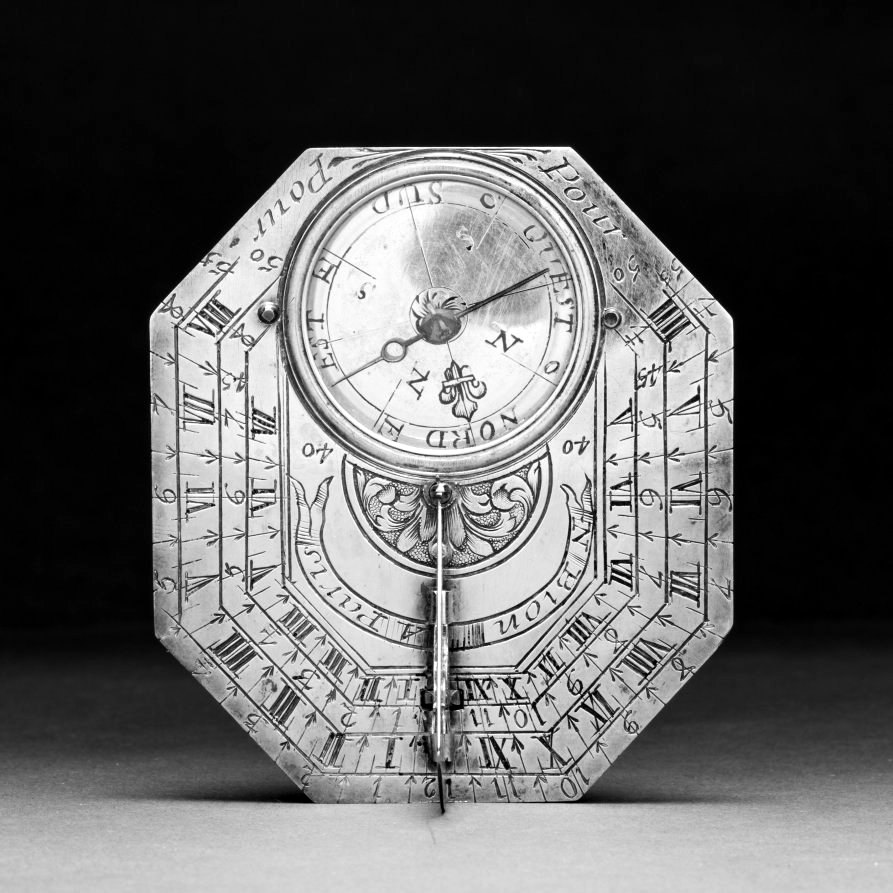
Pocket sundial, France, 1700s. Before the clock, a shadow told the hour
XV
Time is money
The clock on your wall divides time into twelve and sixty. Twelve hours, twice. Sixty minutes, sixty seconds. Those numbers come from Babylon, from the way they divided the circle of the sky into 360 degrees. It is geometry, a measurement of space, laid over time.
Before clocks, the day was the sky. In the ancient world the daylight was split into twelve hours and the night into twelve, so a summer hour was longer than a winter hour. Each of those hours was ruled by one of the seven visible lights, in a fixed order: Saturn, Jupiter, Mars, the Sun, Venus, Mercury, the Moon. Whichever planet ruled the first hour of the day gave the day its name.
You still say those names every week. Saturday is Saturn's day. Sunday is the Sun's. Monday is the Moon's. In English the other four were renamed after Norse gods who stood in for the Roman ones: Tuesday for Tiw (Mars), Wednesday for Woden (Mercury), Thursday for Thor (Jupiter), Friday for Frigg (Venus). In French and Spanish you can still hear the planets: mardi, mercredi, jeudi, vendredi. Martes, miércoles, jueves, viernes.
The seven-day week is a planetary clock. You have been living inside it your whole life without being told.
In 1748, Benjamin Franklin wrote a short piece of advice to a young tradesman. Its most famous line: "Remember that time is money." A century later, factory whistles and railroad schedules forced every town onto the same clock. In 1883, the American railroads split the country into time zones so the trains could run. Noon stopped being the moment the Sun was highest over your town. It became whatever the railroad said it was.
The Maya called their sacred count a way of living in the right time. Every day had a character, and you acted in step with it. People who study the Maya calendar sometimes sum it up as time is art. Our civilization replaced it with the other sentence.
The recordSexagesimal (base 60) numbers in Babylonian mathematics. Cassius Dio, Roman History 37.18 to 19, on the planetary week. Benjamin Franklin, Advice to a Young Tradesman, 1748. Standard time on the American railroads, 18 November 1883.
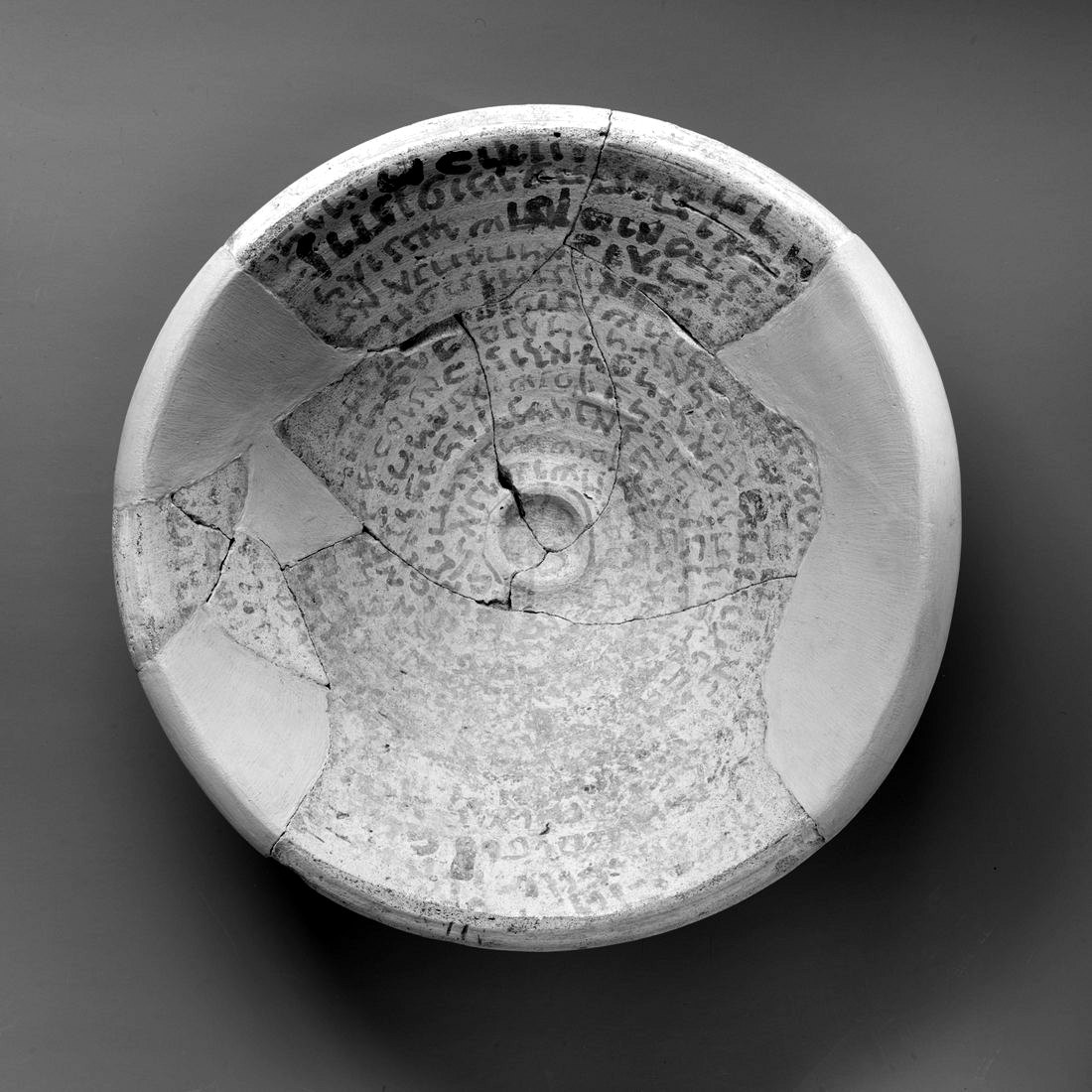
A spell in Aramaic, written in a spiral inside a bowl and buried to trap demons. Mesopotamia, 400s to 500s AD
XVI
The words turned into spells
Go back to chapter one. The world was spoken into being, and the human was made in the image of the one who speaks. If words create, then whoever controls the words controls a great deal.
The English language is full of words that still carry the sky inside them, and words whose meaning was turned. You say them every day.
Spell
Old English spel meant a story or a speech. To spell a word is to set its letters in order. A spell is words set in order to make something happen. Same word.
Gospel
Old English god-spel: the good story, the good news. Read it literally and it is a good spell.
Grammar / glamour
In the Middle Ages, grammar meant all learning, including magic. The French form became grimoire, a book of spells. In Scotland it became glamour: a spell that makes you see something that is not there. The rules of writing, a book of magic, and an illusion of beauty are one word.
Enchant
Latin in-cantare: to sing into someone.
Charm
Latin carmen: a song, a verse, a chant.
Disaster
Italian dis-astro: a bad star. A catastrophe was an event under an ill-placed planet.
Consider
Latin considerare. Very likely con-sidus: to sit with the stars, to study them closely before deciding.
Desire
Latin desiderare, possibly de-sidus: to wait for what the stars will bring. The origin is debated.
Influence
Latin in-fluere, to flow in. In the Middle Ages it meant the invisible stream flowing from the stars into human lives. Influenza was a sickness blamed on the stars.
Contemplate
Latin templum: the patch of sky a Roman priest marked out to watch for signs. To contemplate is to watch the sky for a message.
Inaugurate
From the Roman augur, the priest who read the birds and the sky before any public act. To inaugurate is to take the omens.
Auspicious
Latin avis (bird) and specere (to watch). A good sign in the flight of birds.
Lunatic
From luna, the Moon. Madness was blamed on the Moon's phases.
Jovial, mercurial, martial, saturnine
Born under Jupiter, Mercury, Mars or Saturn. Personality words that are really astrology.
Holiday
A holy day. An appointed time set apart by God, now a day off from work.
Goodbye
A contraction of God be with ye. A blessing, worn down until nobody hears it.
Mortgage
Old French mort gage: a death pledge. The deal dies when the debt is paid, or when you fail to pay it.
None of this is secret. It is in every etymological dictionary. It is simply never taught. So people bless without knowing they are blessing, swear by the stars without knowing they are swearing, and sign death pledges they call home loans.
We did not stop using the old language. We only stopped hearing it.
The Dictionary on this site traces every word used here back to its oldest root, and shows what it meant across cultures and centuries.
The recordOxford English Dictionary and the Online Etymology Dictionary for each word. "Consider" and "desire" from the stars are traditional etymologies that scholars still debate. "Glamour" was popularized in English by Sir Walter Scott.
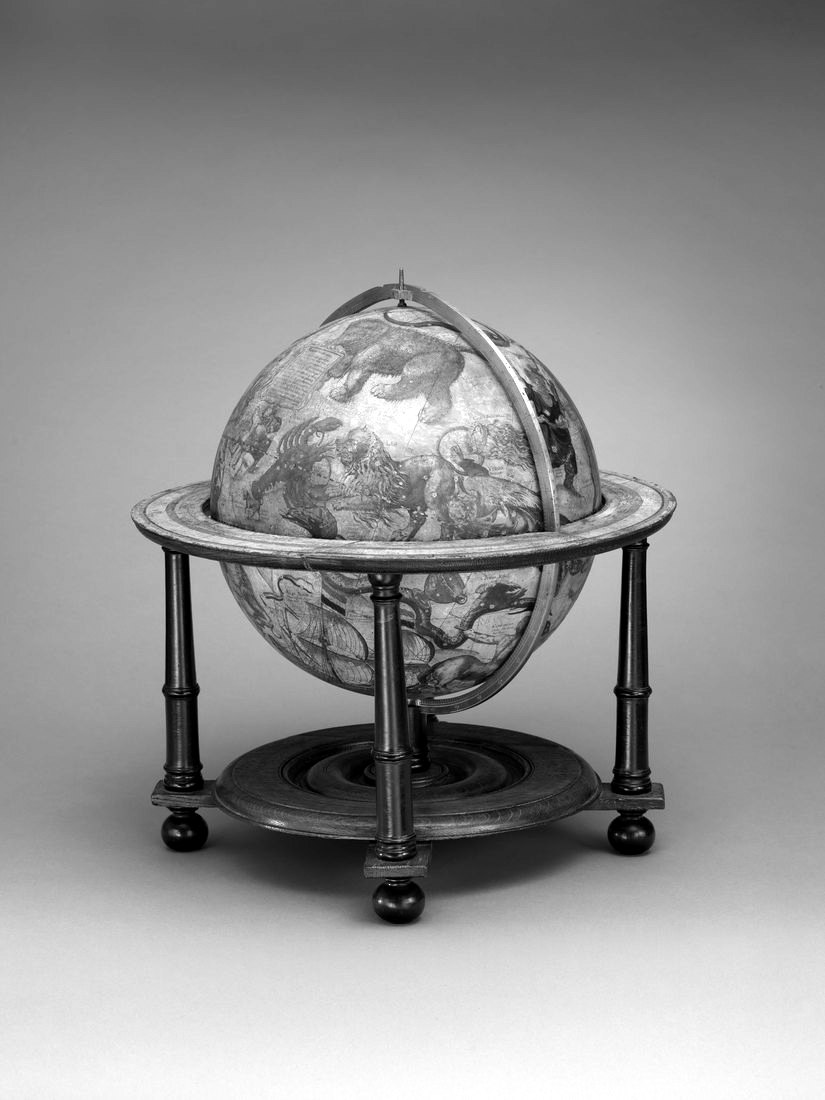
Celestial globe by Willem Jansz Blaeu, Amsterdam, after 1621
XVII
The map stopped matching
Around 130 BC, the Greek astronomer Hipparchus compared his star positions with records from 150 years earlier and found that the stars had all shifted. The Earth wobbles slowly on its axis, like a spinning top. One full wobble takes about 25,800 years. It makes the stars appear to slide about one degree every 72 years against the seasons.
About three hundred years later, the astronomer Ptolemy wrote the textbook that Western astrology used for the next fifteen centuries. He tied the zodiac to the seasons. Aries would start every year on the first day of spring, wherever the stars happened to be. At the time, the season and the stars were close enough that it barely mattered.
It matters now. The stars have slid about 24 degrees since then, almost a whole sign. When a horoscope tells you that you are a Sagittarius, the Sun on your birthday was usually in front of the stars of Scorpio. The seasons stayed. The sky moved. The Western horoscope never updated.
India never made that switch. Vedic astrology, called Jyotish, the science of light, has always measured the zodiac against the real stars, and it adjusts for the drift every year. There is also a thirteenth constellation the Sun passes through every year, Ophiuchus, the serpent holder, which the twelve-sign system leaves out.
Your sign is probably not your sign. The people who kept the older method never lost the stars.
The recordHipparchus, c. 130 BC, on precession. Ptolemy, Tetrabiblos 1.10 and 1.22 (c. 150). The Lahiri ayanamsha (the drift used in India) was about 24°13' in 2026.
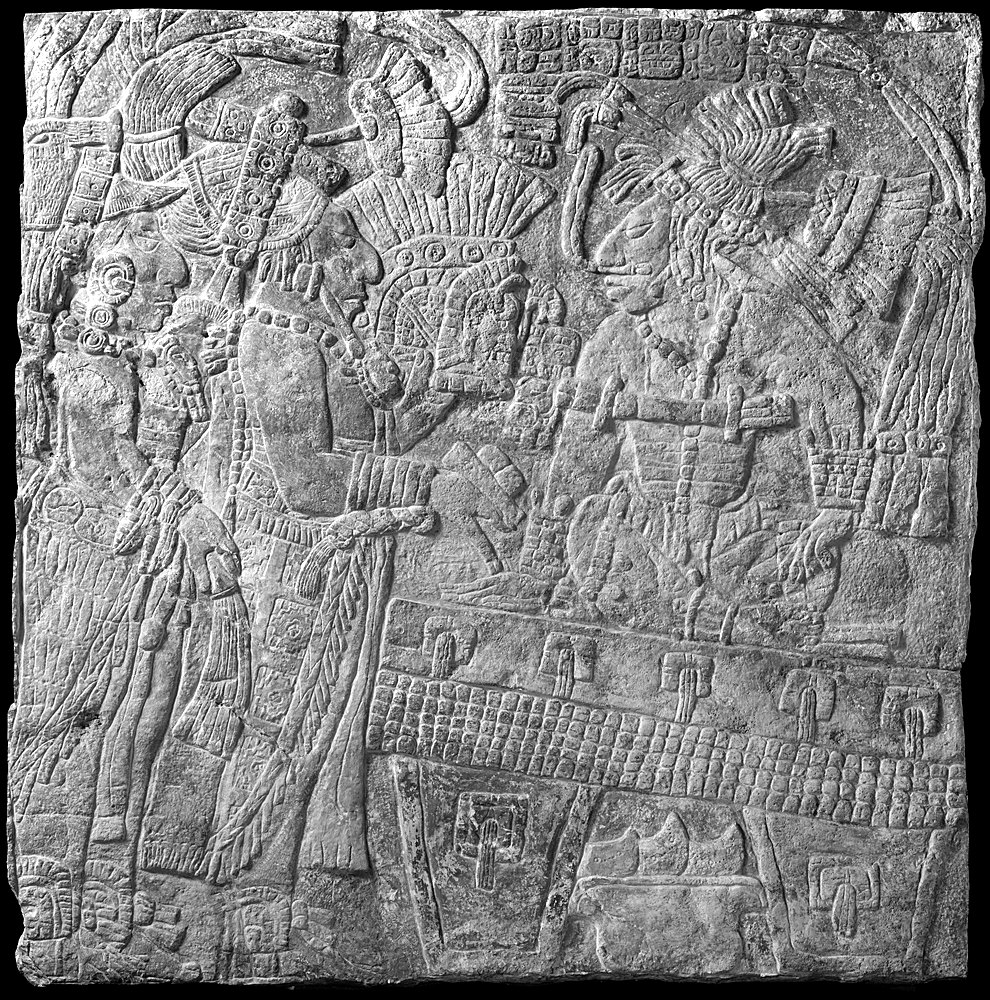
Relief of an enthroned ruler, carved by Chakalte'. Maya, Guatemala, 770 AD
XVIII
The ones who never switched
Line up everything so far and a pattern shows. The sky was installed as a calendar of appointments. People read it. Then, one decision at a time, the West replaced it: a Sunday computed by a council instead of the Passover, a pope's calendar instead of the sky, a railroad's clock instead of the Sun, a seasonal horoscope instead of the stars, books left out of the Bible, words emptied of what they meant.
But in every case, somebody refused. And they kept it.
Observant Jews
Still live by a calendar set by the Moon and the Sun. The day starts at dark, the week ends on the seventh day, and the feasts of Genesis 1:14 are kept on their appointed dates.
The Orthodox churches
Kept the older calendar for their holy days, the older liturgy and the older fasts. Christmas on January 7. Easter still tied to the old reckoning.
Ethiopia
Kept the Book of Enoch and Jubilees in its Bible, kept its own calendar of thirteen months, and counts the years differently. By its count, the year is 2019.
The K'iche' Maya
After the Spanish burned their books, the daykeepers, the Aj Q'ij, kept the 260-day count going in the highlands of Guatemala. It has never skipped a day.
India
Kept Jyotish against the real stars, with the 27 lunar mansions and a timing system of planetary periods that runs 120 years.
China
Kept a calendar of solar terms and moons, and a system of four pillars that reads a birth through the five elements.
These people have almost nothing in common. Different continents, different languages, different gods. What they share is that they kept their own time. And in every case, the people who kept their own time kept their memory.
Control the calendar and you control the rhythm of a people. Keep your own and they cannot erase you.
The recordThe Hebrew calendar (Hillel II). The Julian calendar in the Russian, Serbian, Georgian, Jerusalem and other Orthodox churches. The Ethiopian calendar (Enkutatash, 11 or 12 September). Barbara Tedlock, Time and the Highland Maya, 1982. The Surya Siddhanta. The 24 Chinese solar terms.
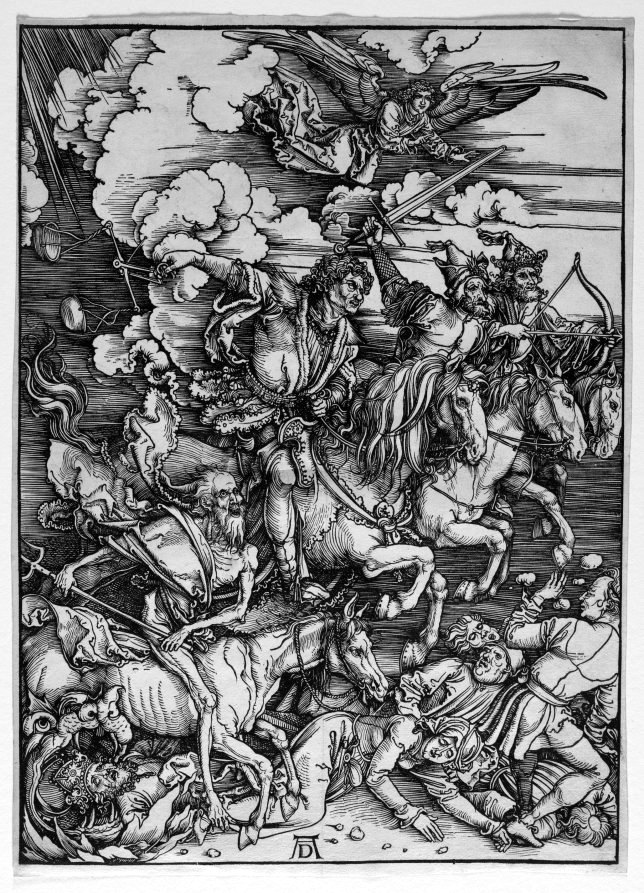
Albrecht Dürer, The Four Horsemen, from The Apocalypse, 1498
XIX
The unveiling
The last book of the Bible is called Revelation. The Greek word is apokalypsis. It does not mean the end of the world. It means pulling back a veil so you can see what was underneath the whole time.
It was written around the year 95 by John, on the island of Patmos, in the language of the Hebrew prophets. Almost every image in it comes from earlier in the Bible. It is the last chapter of one book, and it only makes sense if you have read the rest.
Jesus warned about this age directly: "False messiahs and false prophets will appear and perform great signs and wonders to deceive, if possible, even the elect." Paul wrote about a "powerful delusion" sent to people who would not love the truth. The end of the story is not described as an age of violence first. It is described as an age of deception.
At the sixth seal, "the sun turned black like sackcloth made of goat hair, the whole moon turned blood red, and the stars in the sky fell to earth." The kings of the earth, the generals and the rich hide in caves and call on the mountains to fall on them. They are not confused about what is happening. They finally understand.
Then Babylon the Great, the name for the whole system of the world, falls. The last item on the list of goods she traded is "the bodies and souls of human beings." And a voice from heaven says: "Come out of her, my people, so that you will not share in her sins." God's people are inside the system. The call is to stop drawing your identity and your time from it.
At the end, the Rider on the white horse appears, and "his name is called the Word of God". Ho Logos tou Theou. The same Word from the first page. The last chapter shows a river flowing from the throne, and on both sides of it, the Tree of Life, bearing fruit every month, its leaves for the healing of the nations. The tree that was guarded in Genesis 3 stands open.
The Bible starts with a word spoken over deep water and ends with a word riding out of heaven. It is one thread.
The recordRevelation 1:1 (apokalypsis), 6:12 to 17, 18:4, 18:13, 19:13, 22:1 to 2. Matthew 24:24. 2 Thessalonians 2:11.
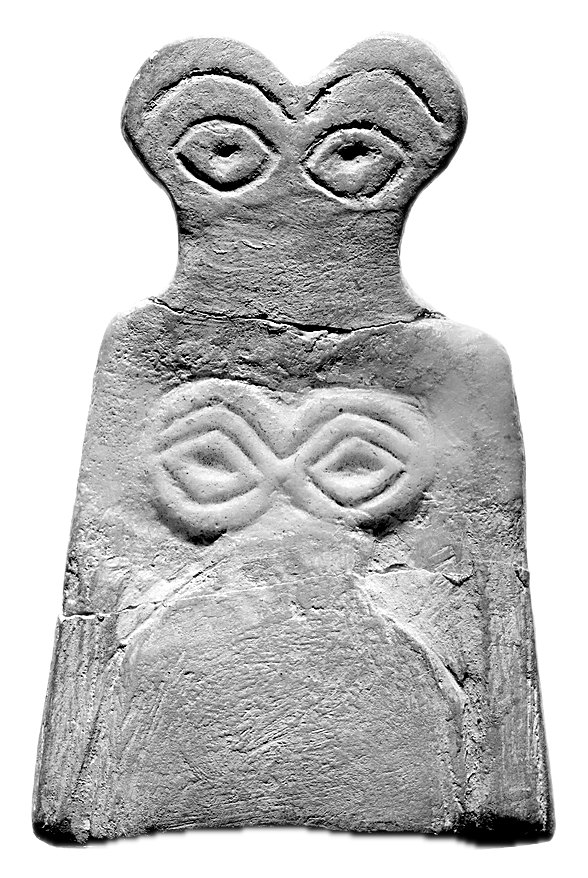
Eye idol. Syria, Uruk period, c. 3700 to 3500 BC
XX
It recorded you too
On March 3, 2026, the Moon went fully dark and rose red. A total lunar eclipse at 12 degrees of Virgo, opposite the Sun in Pisces. Two weeks earlier, on February 19 and 20, Saturn and Neptune met at 0 degrees of Aries, the first degree of the whole zodiac, the point where the cycle starts again.
On the Hebrew calendar, March 3, 2026 was the 14th of Adar. That is Purim, the feast from the Book of Esther: a hidden queen, a decree to destroy her people, and a reversal at the last moment. It is the only book in the Bible where the name of God never appears once. Its whole message is that God was acting while staying hidden. The blood moon rose on the feast of the hidden God.
The same system that recorded that sky recorded the exact second you arrived. At the moment you were born, at your exact place on earth, every planet stood in one arrangement that had never happened before and will never happen again. The Babylonians would have written it down. The magi would have read it. The daykeepers would know the name of your day. Your Hebrew birthday has a letter.
Most people walk around their whole lives with that record unread. They feel the pull of something unfinished and cannot name it. They were given one sign and one personality test and told that was the whole of them.
Every person on this earth holds one piece of a larger picture. When you see yours, all of it at once, across every system that people who never met each other built to read a life, you stop guessing what you are for. And when you do the work your piece is asking of you, you are not only freeing yourself. You are putting your piece back into the picture.
It recorded him before he arrived. It recorded you too.
The recordTotal lunar eclipse of 3 March 2026 (12°52' Virgo, tropical). Saturn-Neptune conjunction, 19 to 20 February 2026, 0°34' Aries. 14 Adar 5786. Esther 9. All checked with the Swiss Ephemeris and the Hebrew calendar.
Your piece
Read your own record.
It recorded you too. Put in your birth and see what the sky held at that moment, measured against where the stars really were.